+ I’m moving out of my property. How do I close my account?
You can schedule your move out either online from your
MyAccount or by calling our office at (905) 876-4611 at least 48 hours prior to your move out date.
+ I’m moving into a property in Milton. How do I set up my account?
You can set up your account by filling in the
Application for Service Form, Request Details (miltonhydro.com), or calling our office at (905) 876-4611 at least 48 hours prior to your move in date.
+ I’m moving within Milton from one address to another. How do I transfer over my services?
You can transfer over your services by logging into your
MyAccount and filling out the
Moving within Milton Form or by calling our office at (905) 876-4611.
+ When will I receive my first bill?
You can expect your first bill about 6 weeks after your move in date.
+ Once I have closed my account, when will I receive my final bill?
Final bills are sent out 2-3 weeks from the requested move out date.
+ I have scheduled my move in with Milton Hydro, when will I receive my log-in credentials for MyAccount?
Log in credentials are sent via email 14 days after the requested move in date.
*If you have not received your log in credentials after 14 days please be sure to check your Junk/Spam folders.
+ I am an existing customer and have never set up an online account, how do I register for MyAccount?
You can register online
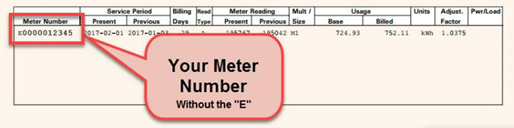
Sign Up | Milton Hydro. You will require your account number and meter number found at the bottom of your bill. If you do not have a copy of your bill, please call our office to obtain the meter number at (905) 876-4611.
+ I have multiple accounts, how can I view all the accounts when I log in?
Sign in to your Milton Hydro MyAccount Customer Portal and click the Change Account button (top left-hand corner) to toggle between multiple accounts.
+ How can I tell which dates I was billed for?
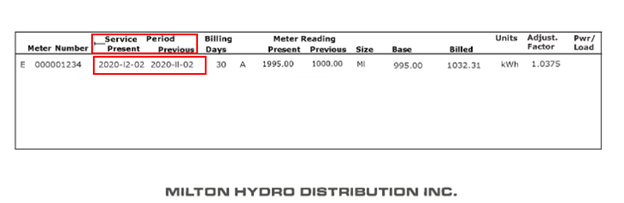
At the bottom of your bill, there is a box outlining service period dates for electric and water services. Dates are listed as “previous” (start date of your bill) and “present” (end date of your bill) as seen in the image below.
+ How do I switch my price plan?
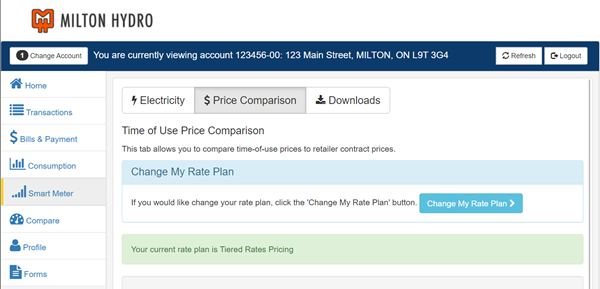
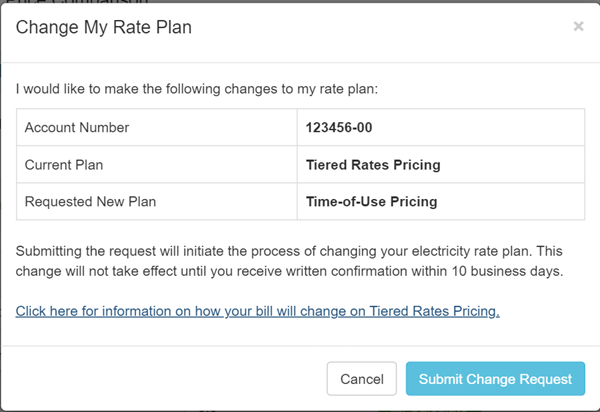
You can switch your rates between Ultra-Low Overnight (ULO), Tiered, and Time-of-Use (TOU) from your
online account under the
Smart Meter tab or by calling our office at (905) 876-4611.
+ How can I pay my bill?
You can pay your bill through your bank online or in person.
You can also pay by:
- Pre-authorized chequing
- Credit Card (Paymentus processing fee)
- Cash or Cheque (Drop box at Milton Hydro office - 200 Chisholm Drive)
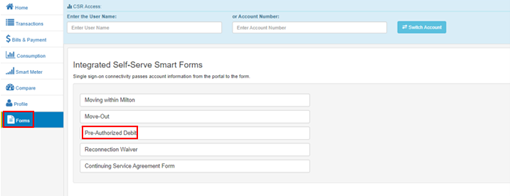
+ How can I set up pre-authorized payments?
You can set up pre-authorized payments by logging into your
Milton Hydro account and filling out the
Pre-Authorized Debit Form from the
Forms tab as seen in the image below.
* Please note you will be required to attach a copy of a void cheque or direct deposit form.
+ Are there any financial assistance programs available to customers?
There may be financial assistance available to you through a Provincial/Regional Program. Please see the list of assistance options below:
+ When do I need a Service Layout?
If you are building a new home or business or you are upgrading or modifying your existing service or meter location, you need a Service Layout.
+ I’m building a new house on a rural property. How far can I build my house from the road before I need a primary service and transformer on the property?
Generally speaking, if you construct a house more than about 90m (270ft) from the road you may require an overhead pole line or underground trenched service with transformer on property. Contact Milton Hydro’s Engineering Department to determine appropriate servicing methods for your property at
engineering@miltonhydro.com.
+ Who installs an underground service?
The customer is responsible for installing underground services including transformer base, ground loop, primary and secondary trenches, conduit, meter base/ cabinet, and primary/ secondary cables (if owned by the customer).
Milton Hydro will supply and install most primary and secondary cabling that will be owned by Milton Hydro. The Offer to Connect and Service Layout for your specific site will provide greater details of our requirements.
+ I am building a new house/ business where there are no power lines. How do I get power to the site?
To begin the process of getting power to your property, complete the
Electrical Requirements Summary Form at the top of this page. We will work with you to establish the best method for getting power to your site, timeframe, and costs. You can also contact the Engineering Department at
engineering@miltonhydro.com or (905) 876-4611 and ask for a consultation.
+ How close can I build my house/ business to a power line?
Buildings should be constructed at minimum of 5m (16ft) from an overhead power line to ensure safety. This minimum meets the Ontario Building Code requirements and Ontario Electrical Safety Code requirements related to proximity of buildings to electrical power lines.
+ Milton Hydro’s website has many construction standards. Can I use these for my service?
The Construction Standards are posted on this page for ease of customer access. The specific standards that apply to your situation will be provided to you as part of the Service Layout process.
+ Process for Connection, Connecting Distributed Energy Resources, & Applications Forms
The process for connecting a distributed energy resource project to the distribution system is outlined our
DER Interconnection Guidelines. We encourage any customers interested in connecting a distributed energy resource to review these guidelines and contact our Engineering Department to discuss your project.
Customers requesting a pre-consultation with Milton Hydro about their project can complete our DER
Preliminary Consultation Information Request Form (PCIR). We recommend completing the initial preliminary consultation stage prior to submitting a Connection Impact Assessment (CIA) application and making significant project investments to determine the viability of your project. Application forms can be submitted to
generation@miltonhydro.com.
Application Forms & Pre-Consultation
Pre-consultation Request From (PCIR) - Complete the PCIR tab and submit to Milton Hydro
Connection of Micro-Embedded Generator Application Form (<=12kW)
Connection Impact Assessment Application Form (>12kW up to 10MW)
Protection Philosophy Requirements Form (12kW up to 10MW)
Please note: All documents must be signed and sealed by a Professional Engineer
Milton Hydro’s Engineering Department will review all pre-consultation and connection impact assessment applications for completeness. Approximate response times for completed applications are 15 business days for PCIR forms.
Applicants applying to connect generation projects greater than 12kW shall submit the Connection Impact Assessment Application with single line diagram, site plan, and their Protection Philosophy. Applicants shall ensure their protection philosophy follows Milton Hydro's protection philosophy linked above.
Applicants should be aware that connection impact assessments can take up to 60 days to complete where no distribution system expansion is required, and no upstream transmitter CIA is required. Applicants will be advised of any expected delays.
A completed CIA along with Connection Cost Agreement (Offer to Connect) outlining requirements for connection and any system upgrades that may be necessary, and the applicable Connection Agreement will be provided to the applicant.
Commissioning & Equipment Verification Report (CVER)
Applicants eligible for Simplified CIA's or where projects are allocated threshold capacity are required to complete the Commissioning & Equipment Verification Report (CVER) A copy will be sent with the Offer to Connect and Connection Cost Recovery Agreement.
Commissioning & Equipment Verification Report (CVER)
+ Net Metering at Milton Hydro
Thinking about reducing your electricity costs by generating your own electricity? Then you may be interested in Milton Hydro’s Net metering program. Read on to learn more about our Net Metering program for generation of 500kW or less and the steps involved.
What is Net metering?
- Net metering measures the consumption of electricity you use against the amount of electricity you generate resulting in a “net” total from which your bill is calculated.
- Net Metering is ideal for those looking to reduce electricity costs.
- Under the Net Metering Agreement, excess generation credits can be carried forward up to twelve months to offset future electricity costs.
- Applicable generation types for net metered connections include renewable energy sources such as Solar PV, wind, and water.
How will my bill be calculated?
Milton Hydro will continue to read your meter as we do now. The bill you see will reflect the difference between the value of the electricity you return to the grid and the value of electricity you consume from the grid. If your net consumption for a billing period is zero, or results in a credit, the delivery portion of your bill will not include kilowatt-hour-based charges and the net credit will be carried forward to the next billing cycle. Settlement of Net Metered accounts will follow O.Reg. 541/05.
What is the process to connect to Milton Hydro’s Distribution System?
- Complete the Pre-consultation Request Form (PCIR) and submit to Milton Hydro.
- Milton Hydro’s Engineering Department will provide a response to your PCIR within approximately 10-15 days.
- If there is sufficient capacity to connect your project, make an application to Milton Hydro using:
- Milton Hydro’s Engineering Department will review your application for completeness and process your application is accordance with our Conditions of Service and the Ontario Energy Board’s (OEB) Distribution System Code.
- Milton Hydro recommends that all generator equipment be certified by the Canadian Standards Association (CSA). If it isn’t, equipment must be site-certified by the Electrical Safety Authority (ESA).
- Installation of all generation facilities must be approved by the ESA and Connection Authorization provided to Milton Hydro prior to connection.
- To comply with Section 84 of the Ontario Electrical Safety Code, you are required to have an isolation switch (visible, accessible, and lockable) located between the meter and your equipment.
Technical and Metering
All generation sites shall comply with Milton Hydro’s Conditions of Service, applicable agreements, Ontario Electrical Safety Code and applicable laws, regulations, and codes.
In order to bill you on a net metering basis and comply with the requirements of Measurement Canada, meter replacement may be required. You will be responsible for costs associated with Milton Hydro upgrading the meter for your installation.
Agreements for Net Metering
Connection Costs
You will be responsible for the costs of any modifications to Milton Hydro’s distribution system, including transformer changes needed to connect your generation facility. You will also be responsible for any remote telemetry units (RTU’s), radios, and other devices that may be necessary where Milton Hydro requires site monitoring and control of your generation project. Applicable costs related to your project are provided as part of our Connection Cost Agreement.
+ Connection Cost Guidance & Impact Assessment Fees
This Guidance document has been prepared by Milton Hydro to provide Distributed Energy Resource (“DER”) applicants with information on Milton Hydro’s performance related to the estimation of DER connection costs (the “Guidance Document”), in particular, but not limited to, information on what a DER applicant can or cannot expect in terms of the accuracy of the estimates that Milton Hydro will or has provided to the DER applicant during the connection process in respect of the cost of the work to be performed by Milton Hydro on its distribution system to connect the DER applicant’s facility to Milton Hydro’s distribution system.
These fees are to be used in Section P “CIA Application Fee Checklist” of the Connection Impact Assessment Application Form.
| |
Subtotal |
HST |
Total |
| >12kW up to 250kW (Capacity Allocated Feeder) |
$ 7,356.55 |
$ 956.35 |
$ 8,312.90 |
| >12kW up to 500kW (Non-Capacity Allocated Feeder) |
$ 7,356.55 |
$ 956.35 |
$ 8,312.90 |
| >250kW up to 10MW (All DER projects greater than 250kW) |
$ 19,908.60 |
$ 2,588.12 |
$ 22,496.72 |
| Simplified CIA (>12kW up to 100kW) - Threshold Capacity Available |
$ 3,910.00 |
$ 508.30 |
$ 4,418.30 |
Prices are subject to change without notice. Applicants should ensure fees are current prior to submitting an application.
Projects greater than 250kW and/ or connecting to a non-capacity allocated feeder require a CIA by the upstream transmitter. Milton Hydro will advise applicants when upstream transmitter CIA’s are required, and will apply to the upstream transmitter for their CIA on behalf of the applicant.
Applicants shall include CIA payment with completed application including site drawings, electrical single line diagrams, protection philosophy, and other information as may be required to fully assess the project.
+ Connection Agreements
All generation connections require a Connection Agreement. As part of the connection process, customers will receive Milton Hydro’s appliable agreement with the Connection Cost Agreement.
+ Restricted Feeder Information
Currently there are no feeder restrictions for connecting Distributed Energy Resources (DER) in Milton Hydro’s distribution territory.
+ Energy Industry Links
The Ontario Energy Board (OEB) website contains useful information about DER and EV connections, process, and documentation. Milton Hydro recommends you also review information available on OEB’s website.
+ What is the Green Button program all about?
Green Button is a data standard that provides energy customers with more choice in how you access your electricity and natural gas data.
With a simple and secure process, customers will be able to securely download (access) or connect (share) their energy usage data in an industry-standard format with registered third parties.
Watch the video above to better understand the Green Button program.
+ What is the benefit of the Green Button Program?
Green Button provides a unified, industry-standard data format, which can be used to analyze and manage a consumer’s energy usage. The introduction of Green Button industry-standard data across Ontario utilities will provide the foundation for the development of new tools and applications for customers to analyze and monitor their energy usage to reduce costs.
Below are just a few of the benefits of Green Button data:
- Improve energy efficiency – Consumers can use Green Button data to identify and compare their energy usage in order to improve energy-efficiency within their home or business.
- Reduce energy costs -By learning their usage patterns and habits, consumers can make informed choices about how much energy they use and when they use it. When consumers use energy during off-peak hours (also known as peak-shaving) and invest in energy-efficient appliances, it saves money and can help reduce strain on the grid.
- Energy conservation –consumers can use their data to conserve energy to help reduce their carbon footprint and protect the environment.
- Green button tools to understand large volumes of energy data will help pave the way for future innovations in the energy sector.
Green Button Data for Residential and Small Commercial Customers:
- Many customers are already viewing their energy data through a customer portal on their utility website. With Green Button, third party apps can analyze the data and provide insights to help customers make sense of their energy use and make informed decisions to help reduce costs.
- With CMD, data is shared on an ongoing basis. This allows third parties to provide insights and alerts on usage trends and changes.
Green Button Data for Businesses:
- For customers with a large number of properties across multiple utilities, Green Button provides a standardized format so that the data they receive from each utility is in a similar format. Green Button third parties in the commercial sector are able to analyze large volumes of data across multiple facilities to provide energy management advice.
- With CMD, data is shared on an ongoing basis. This allows third parties to provide insights and alerts on usage trends and changes including monitoring the impact of energy efficiency measures taken.
- Green Button will also make it easier for facilities to complete mandatory government reporting requirements.
+ What can I do with the data I download?
When you download your data, you can review it yourself, upload it to an application to analyze, or send it to a third-party vendor to analyze.
+ How can I access Green Button?
You can download your Green Button data one of the following ways:
From MyAccount:
Log in to MyAccount
- Click the Smart Meter Tab.
- Click Downloads.
- Select the Green Button.
- Follow the prompts to select the data you would like to download.
- Click Download.
- An XML file containing your selected data will be downloaded.
- This file can be shared with a third-party or uploaded to a Green Button app to view.
From the Milton Hydro Website:
- Go directly to the Green Button Portal .
- Enter your required account information to validate that you are the account owner (Note: You will need to have a recent bill handy).
- Select the Download My Data tab.
- Follow the prompts to select the data you would like to download.
- Click Download.
- An XML file containing your selected data will be downloaded.
- This file can be shared with a third-party or uploaded to a Green Button app to view.
+ How do I know that my data is secure?
Milton Hydro has been certified by the
Green Button Alliance. This is the industry standard to ensure compliance with data sharing and security standards.
Third-party vendors must also be certified by the Green Button Alliance to be authorized as a registered vendor. Before you authorize a third-party vendor, be sure to carefully read the terms and conditions on their website so that you understand how they will use, share, or retain your data.
+ What format will my data be downloaded in?
When you download your data, it will be in an industry-standard XML format. Please note that XML files are designed to be read and analyzed by computer applications, not humans.
+ What data is shared with the authorized third-party vendor(s)?
When authorizing a third-party vendor to access your data, you will select the type of data you want to share with them and for which account (if you have multiple accounts).
You can select your Energy Usage Data, Billing Data and/or Account Information to be shared. Your utility provider will share the type of data you have selected and authorized for that account.

+ How do I find a third-party vendor to share my data with through Green Button?
Data can be shared with authorized third-party vendors that have registered with and been authorized by Milton Hydro to use
Connect My Data.
Below is a list of third-party vendors currently registered with Milton Hydro:
- Currently, there are no third-party vendors registered with Milton Hydro. Customers will not be able to share their data with third-party vendors until Milton Hydro has registered a third-party vendor.
+ Who do I contact for help with using the Green Button program?
Our
Customer Experience team would be happy to speak with you about the Green Button program. They can be reached M-F 8:30 am – 4:30 pm at (905) 876-4611.
You can also contact the
Ontario Energy Board at 1(877) 632-2727.
+ Can a vendor submit an authorization form on behalf of a customer to access their data?
Customers are required to make their own authorizations online through one of the authorization methods.
The customer must also authenticate with the utility before the security token can be exchanged with the utility and data can be shared.
+ How long does a third-party vendor have access to customer data?
The customer selects the duration for which the data will be shared with an authorized third-party vendor, along with the frequency that the data will be shared.
The customer can revoke access at any time.
+ Can I stop sharing my data with a third-party vendor?
Yes, you can stop sharing your data with a third-party vendor at any time.
To do so, simply go to the Data Shares tab within the Milton Hydro Green Button portal, select the vendor you would like to stop sharing your data with, and click Revoke.
+ How long will my data be shared with an authorized third-party vendor?
When authorizing a third-party vendor to access your data, you select the duration and frequency that you would like to share your data for.
+ Simplified Connection Impact Assessment (CIA) and Commissioning Guidelines
Milton Hydro offers a Simplified Connection Impact Assessment (CIA) compliant with OEB Guidelines that are designed to streamline the process of connecting small-scale generation projects (≤100 kW) to the electricity distribution grid. These guidelines help ensure that new small scale distributed energy resources (DERs), such as rooftop solar, small wind turbines, and battery storage, can be integrated efficiently while maintaining grid safety, reliability, and power quality.
Eligibility Criteria
To qualify for the Simplified CIA process, a project must meet specific conditions, including:
- A nameplate capacity of:
- >12kW and ≤ 30kW (single phase, 16kV or less); or
- >30kW and ≤ 100kW (single/ three phase, 16kV or less).
- Located in an area where the total generation on the feeder does not exceed 7% of the annual peak load.
- The project does not require an upstream distribution or transmission system impact assessments.
- Compliance with technical and safety requirements of Milton Hydro.
If a project does not meet these criteria, it must undergo a Full CIA, which involves a more detailed technical assessment.
Application and Review Process
Step 1: Preliminary Screening
The project proponent must first consult with the MHDI to determine whether the project qualifies for a Simplified CIA. To being the preliminary consultation complete and submit the Pre-consultation Request Form (PCIR) and submit to engineering@miltonhydro.com. Our Engineering Department staff will contact you within 15 business days to discuss your proposal and provide a response.
If the pre-consultation identifies the applicant’s proposal meets the criteria for a Simplified CIA, Milton Hydro’s Engineering Department will advise the applicant of next steps to submit a CIA application.
Step 2: Application Submission
Once deemed eligible, the applicant submits an CIA Application form found in the Forms section of the website. This includes technical details such as:
- Project location and connection point.
- Equipment specifications (e.g., inverter ratings, protective relays).
- Load flow analysis and expected generation capacity.
- Single Line Diagram that includes at minimum the sources of generation, wire sizes, protective devices and IEEE numbers, meter location, utility disconnect switch, Point of Common Coupling (PCC), and Point of Connection (POC).
- Site plan showing location of generation, utility disconnect switch, and meter.
- Protection philosophy (see Milton Hydro's Condition of Service and OEB DERCP Guidelines).
- Proposed project schedule.
- The application, single line diagram, and protection philosophy must be sealed by a Professional Engineer (for projects > 30kW).
Additionally, the applicant shall submit payment for the CIA is accordance with Milton Hydro’s CIA fee structure with their application.
Step 3: Connection Impact Assessment
Once a full application is received, Milton Hydro will begin a Connection Impact Assessment (CIA). The CIA will review the proposed projects:
- Impact on voltage levels at the connection point.
- Protection coordination with existing grid infrastructure.
- Power quality considerations, such as harmonics and flicker.
Step 4: Approval or Further Study
- Following completion of the CIA, if no significant distribution system impact is identified, the project is approved under the Simplified CIA process.
- Milton Hydro will provide the applicant with a Connection Cost Recovery Agreement (CCRA), CIA report, a Commissioning & Equipment Verification Report (CVER), and Connection Agreement within approximately 45 business days following a complete submission. Additional related information as applicable will be provided.
- If potential issues are found, Milton Hydro will advise the proponent that a full CIA possibly including upstream LDC is required to conduct a more detailed technical review.
Step 5: Construction, Telemetry, and Commissioning
The applicant shall provide Milton Hydro with a current construction schedule that includes provisions for MHDI telemetry point verification testing and commissioning.
Milton Hydro Engineering staff will advise the applicant of any missing information, agreements, or fees.
Once approved by Milton Hydro’s Engineering Department, the applicant can start making material investments in their equipment.
Telemetry (if required):
- Milton Hydro will supply and install a radio which the applicant shall connect their Real-Time Automation Controller (RTAC).
- The applicant shall provide any telemetry points and network information to Milton Hydro a minimum of eight (8) weeks prior to commissioning to allow Milton Hydro sufficient time to add the project to our SCADA.
- Approximately three (3) weeks prior to commissioning, perform a point verification test of telemetric points and record the results.
Step 6: Commissioning
The applicant shall schedule with Milton Hydro their commissioning date at minimum three (3) weeks in advance to allow for Engineering and Control Room staff to schedule resources.
- The applicant is required to complete Milton Hydro’s Commissioning and Equipment Verification Report (CVER) and submit to Milton Hydro prior to permanent use of the DER. The CVER shall be sealed by a Professional Engineer registered with Professional Engineers Ontario (PEO).
- Accompanying the CVER, the applicant shall submit a letter sealed by a Professional Engineer attesting that:
- The DER has been constructed and commissioned in accordance with CSA, OESC, IEEE, and other applicable industry standards, provincial and local laws, by-laws, Act’s, and Regulations.
- The DER’s operations are consistent with the protection philosophy and all protective equipment has been installed, commissioned, and operated as designed.
- Submit their own commissioning and test reports in addition to CVER.
- Conduct a live point verification test of all telemetric data ensuring that MHDI’s SCADA shows proper values (if applicable).
- The applicant shall provide ESA Connection Authorization for temporary connection during commissioning and a final Connection Authorization for continued operation of their DER.
- When satisfied, Milton Hydro shall advise the applicant they can continue operation of their DER.
Step 7: Post Commissioning
Following successful commissioning, the applicant shall submit as-built drawings including single line diagrams.
Milton Hydro shall submit a Letter of Equivalency to Hydro One as applicable.
Approximately 2 months following project completion, Milton Hydro shall provide the applicant with a final cost report and provide a refund or request additional payments as applicable.
Next Steps for Prospective Applicants
If you are uncertain whether your project qualifies for the simplified CIA process, contact our engineering department at engineering@miltonhydro.com.
Applicants should work closely with Milton Hydro’s Engineering Department to ensure compliance with our connection requirements. If a project does not qualify for the Simplified CIA, Milton Hydro will guide the applicant through the full CIA process. To begin the process complete and submit the Pre-consultation Request Form (PCIR) and submit to engineering@miltonhydro.com. Our Engineering Department staff will contact you within 15 business days to discuss your proposal and provide a response.
+ DEVELOPER - I am building a new residential or business development and a system expansion is required.
The Ontario Energy Board (OEB) is developing a Capacity Allocation Model (CAM) to manage how limited electricity system capacity is allocated for new connections, particularly in growing residential developments. CAM aims to create a transparent, standardized process for prioritizing projects when grid capacity is constrained, reducing uncertainty and delays for developers. By clarifying allocation rules and aligning them with Ontario’s housing growth objectives, CAM helps developers plan projects more effectively and avoid costly redesigns or cancellations. This process also supports fair access to capacity, ensuring that system expansions and upgrades are coordinated to meet increasing demand efficiently.
Milton Hydro's minimum service size is 200A, with an estimated demand load of 3-5kW per average residential service.
Developers planning projects within the Milton Hydro service area should refer to the CAM Appendix linked below and the OEB's website (https://engagewithus.oeb.ca/system-expansion-for-housing-developments-consultation) for more information.
CAM-Appendix_20250417.PDF
+ What is the CCIM?
- The CCIM is an online tool created by the OEB to give users a high-level view of where there’s available capacity on Ontario’s electricity distribution systems. In simple terms, it helps users see two main things:
- Available load capacity: The ability to serve new or expanded electricity demand.
- Available hosting capacity for DERs: The ability to connect new projects like solar panels, wind turbines, or battery storage.
+ How to use the CCIM?
The CCIM is a planning aid, designed for early-stage screening. Users can use the tool to quickly check which areas might be suitable for their project before contacting a distributor. The map shows capacity in broad ranges and reflects system conditions at the time distributors submitted their data. It’s not a substitute for detailed assessments, as conditions can change and every project has unique requirements.
+ What is the difference between the available load capacity and the available DER hosting capacity map environments?
- The CCIM provides two distinct map environments because they serve different purposes:
- The Available DER Hosting Capacity map environment focuses on the ability of the grid to integrate DERs like solar panels, battery storage or other generation facilities. It highlights where the system is expected to be able to host additional generation without causing reliability or safety issues. Data is provided for a range of typical project types, such as inverter- or non-inverter based installations, as well as for projects designed only to displace a customer’s load rather than inject power.
- The Available Load Capacity map environment shows areas of the electricity distribution system that can accommodate new customer loads—such as housing developments, commercial buildings, or industrial facilities—without requiring major system upgrades. This helps businesses and developers identify locations where connecting new demand is likely to be simpler and faster.
Both map environments are intended for preliminary screening only and do not replace any formal connection application or Connection Impact Assessment (CIA) process. They provide early insights to help users plan projects and reduce uncertainty before engaging in detailed engineering studies.
+ Who should use the CCIM?
The CCIM is designed for anyone planning electricity-related projects in Ontario. Key stakeholders include:
- Large energy consumers evaluating suitable locations for new facilities.
- Municipal planners and consultants seeking high-level capacity insights for community growth or electrification strategies.
- Renewable energy and DER developers assessing where solar, wind, or battery projects can be hosted without major grid upgrades.
- Project developers and businesses looking to identify areas where new or expanded electricity demand can be connected easily.
- The CCIM provides early-stage screening to reduce uncertainty before engaging distributors for detailed assessments.
+ Distribution Energy Resource (DER) Hosting Capacity
Milton Hydro is committed to providing customers and developers with clear, transparent, and timely information regarding the connection of Distribution Energy Resources (DERs), including generation and energy storage, to the distribution system.
This page describes how Milton Hydro assesses DER hosting capacity at the pre‑consultation stage, in accordance with Ontario Energy Board (OEB)‑approved DER connection processes. The information provided is intended to support early project planning only.
Important Notice
- Hosting capacity information provided through the pre‑consultation process is non‑binding and does not guarantee approval of a DER connection.
- Final approval remains subject to detailed technical review, required studies, and execution of all applicable agreements.
- Hosting capacity may change over time due to system loading, system upgrades, or other DER connections.
Pre‑Consultation Information Request (PCIR)
Customers proposing a DER connection must submit a
Pre‑Consultation Information Request (PCIR) using Milton Hydro’s
online PCIR form.
Following receipt of a completed PCIR, Milton Hydro Engineering staff will review the proposed DER connection and provide high‑level information related to:
- Available distribution system hosting capacity
- Known system constraints or limitations
- The potential need for detailed impact studies
The PCIR process is intended to support informed project development and does
not constitute permission to connect.
Hosting Capacity on Hydro One–Supplied Feeders (44 kV and 27.6 kV)
For customers supplied by
Hydro One feeders serving the Town of Milton, Milton Hydro assesses upstream hosting capacity using
publicly available information published by Hydro One, including the
Hydro One Station Capacity Calculator.
This approach applies to all:
- 44 kV Hydro One feeders supplying Milton Hydro, and
- 27.6 kV Hydro One feeders supplying Milton Hydro.
Milton Hydro uses this information to confirm whether sufficient upstream station and feeder capacity appears to be available to support the proposed DER connection.
Hosting Capacity on Milton Hydro Rural Substation and 8.32 kV Feeders
For DER connections to
Milton Hydro‑owned rural substations and 8.32 kV distribution feeders, hosting capacity is assessed using generally accepted utility planning practices.
As a planning guideline:
- DER capacity on an individual 8.32 kV feeder is typically limited to approximately 50% of the feeder’s peak load, and
- Total DER capacity connected to the rural substation is typically limited to approximately 50% of the substation’s peak load.
Where a feeder or substation is approaching its capacity limits, Milton Hydro will evaluate the potential to accommodate additional DER connections on a
case‑by‑case basis.
Capacity Tracking and Management
To ensure fairness, transparency, and system reliability:
- DER capacity allocated on Milton Hydro’s rural 8.32 kV distribution system is tracked by Engineering staff, and
- Available capacity is reviewed prior to allocating capacity to new DER projects.
Engineering Review and Upstream Verification
Before advising a customer that hosting capacity appears to be available, Milton Hydro Engineering staff will:
- Review available capacity on the applicable 8.32 kV distribution feeder, and
- Verify that sufficient capacity exists on the upstream Hydro One 44 kV or 27.6 kV feeder, where applicable.
PCIR Response
If the hosting capacity review indicates that the proposed DER connection can be accommodated at a high level:
- Milton Hydro will advise the customer that sufficient connection capacity appears to be available, and
- A formal response will be issued through the PCIR process.
Customers should note that confirmation of hosting capacity at the PCIR stage does not replace the formal DER connection application and approval process.
Table 1: DER Capacity Connections to Milton Hydro System Voltages
| Generator Classification |
Rating |
| Micro |
≤ 12 kW |
| Small |
- ≤ 500 kW connected on distribution system voltage <15kV
- ≤ 1 MW connected on distribution system voltage ≥ 15kV
|
| Mid-Sized |
- ≤10 MW but > 500 kW connected on distribution system
voltage < 15 kV
- > 1 MW but ≤ 10 MW connected on distribution system
voltage ≥ 15 kV |
| Large |
≥ 10 MW |
+ Simplified Connection Impact Assessment (CIA) and Commissioning Guidelines
Milton Hydro offers a Simplified Connection Impact Assessment (CIA) compliant with OEB Guidelines that are designed to streamline the process of connecting small-scale generation projects (≤100 kW) to the electricity distribution grid. These guidelines help ensure that new small scale distributed energy resources (DERs), such as rooftop solar, small wind turbines, and battery storage, can be integrated efficiently while maintaining grid safety, reliability, and power quality.
Eligibility Criteria
To qualify for the Simplified CIA process, a project must meet specific conditions, including:
-
A nameplate capacity of:
-
>12kW and ≤ 30kW (single phase, 16kV or less); or
-
>30kW and ≤ 100kW (single/ three phase, 16kV or less).
-
Located in an area where the total generation on the feeder does not exceed 7% of the annual peak load.
-
The project does not require an upstream distribution or transmission system impact assessments.
-
Compliance with technical and safety requirements of MHDI.
If a project does not meet these criteria, it must undergo a Full CIA, which involves a more detailed technical assessment.
Application and Review Process
Step 1: Preliminary Screening
The project proponent must first consult with the MHDI to determine whether the project qualifies for a Simplified CIA. To being the preliminary consultation complete and submit the Pre-consultation Request Form (PCIR) and submit to engineering@miltonhydro.com. Our Engineering Department staff will contact you within 15 business days to discuss your proposal and provide a response.
If the pre-consultation identifies the applicant’s proposal meets the criteria for a Simplified CIA, Milton Hydro’s Engineering Department will advise the applicant of next steps to submit a CIA application.
Step 2: Application Submission
Once deemed eligible, the applicant submits an CIA Application form found in the Forms section of the website. This includes technical details such as:
- Project location and connection point.
- Equipment specifications (e.g., inverter ratings, protective relays).
- Load flow analysis and expected generation capacity.
- Single Line Diagram that includes at minimum the sources of generation, wire sizes, protective devices and IEEE numbers, meter location, utility disconnect switch, Point of Common Coupling (PCC), and Point of Connection (POC).
- Site plan showing location of generation, utility disconnect switch, and meter.
- Protection philosophy (see MHDI Condition of Service and OEB DERCP Guidelines).
- Proposed project schedule.
- The application, single line diagram, and protection philosophy must be sealed by a Professional Engineer (for projects > 30kW).
Additionally, the applicant shall submit payment for the CIA is accordance with MHDI’s CIA fee structure available at (WEBSITE) with their application.
Step 3: Connection Impact Assessment
Once a full application is received, MHDI will being a Connection Impact Assessment (CIA). The CIA will review the proposed projects:
- Impact on voltage levels at the connection point.
- Protection coordination with existing grid infrastructure.
- Power quality considerations, such as harmonics and flicker.
Step 4: Approval or Further Study
- Following completion of the CIA, if no significant distribution system impact is identified, the project is approved under the Simplified CIA process.
- Milton Hydro will provide the applicant with a Connection Cost Recovery Agreement (CCRA), CIA report, a Commissioning & Equipment Verification Report (CVER), and Connection Agreement within approximately 45 business days following a complete submission. Additional related information as applicable will be provided.
- If potential issues are found, Milton Hydro will advise the proponent that a full CIA possibly including upstream LDC is required to conduct a more detailed technical review.
Step 5: Construction, Telemetry, and Commissioning
The applicant shall provide Milton Hydro with a current construction schedule that includes provisions for MHDI telemetry point verification testing and commissioning.
Milton Hydro Engineering staff will advise the applicant of any missing information, agreements, or fees.
Once approved by Milton Hydro’s Engineering Department, the applicant can start making material investments in their equipment.
Telemetry (if required):
- Milton Hydro will supply and install a radio which the applicant shall connect their Real-Time Automation Controller (RTAC).
- The applicant shall provide any telemetry points and network information to Milton Hydro a minimum of eight (8) weeks prior to commissioning to allow Milton Hydro sufficient time to add the project to our SCADA.
- Approximately three (3) weeks prior to commissioning, perform a point verification test of telemetric points and record the results.
Step 6: Commissioning
The applicant shall schedule with Milton Hydro their commissioning date at minimum three (3) weeks in advance to allow for Engineering and Control Room staff to schedule resources.
- The applicant is required to complete Milton Hydro’s Commissioning and Equipment Verification Report (CVER) and submit to Milton Hydro prior to permanent use of the DER. The CVER shall be sealed by a Professional Engineer registered with Professional Engineers Ontario (PEO).
- Accompanying the CVER, the applicant shall submit a letter sealed by a Professional Engineer attesting that:
- The DER has been constructed and commissioned in accordance with CSA, OESC, IEEE, and other applicable industry standards, provincial and local laws, by-laws, Act’s, and Regulations.
- The DER’s operations are consistent with the protection philosophy and all protective equipment has been installed, commissioned, and operated as designed.
- Submit their own commissioning and test reports in addition to CVER.
- Conduct a live point verification test of all telemetric data ensuring that MHDI’s SCADA shows proper values (if applicable).
- The applicant shall provide ESA Connection Authorization for temporary connection during commissioning and a final Connection Authorization for continued operation of their DER.
- When satisfied, Milton Hydro shall advise the applicant they can continue operation of their DER.
Step 7: Post Commissioning
Following successful commissioning, the applicant shall submit as-built drawings including single line diagrams.
Milton Hydro shall submit a Letter of Equivalency to Hydro One as applicable.
Approximately 2 months following project completion, Milton Hydro shall provide the applicant with a final cost report and provide a refund or request additional payments as applicable.
Next Steps for Prospective Applicants
If you are uncertain whether your project qualifies for the simplified CIA process, contact our engineering department at engineering@miltonhydro.com.
Applicants should work closely with Milton Hydro’s Engineering Department to ensure compliance with our connection requirements. If a project does not qualify for the Simplified CIA, Milton Hydro will guide the applicant through the full CIA process. To begin the process complete and submit the Pre-consultation Request Form (PCIR) and submit to engineering@miltonhydro.com. Our Engineering Department staff will contact you within 15 business days to discuss your proposal and provide a response.