
Just moved to the Milton area and need a new account? Please visit our Moving In page.
Doing some work and need a temporary disconnect? Contact us at engineering@miltonhydro.com to arrange it ahead of the work date.
Building a new home or business? Renovating and upgrading your business electrical service? Read on to understand the process.
Our Service Layout Process walks you through the requirements for connections, roles, and responsibilities, and establishes the point of connection for the service.
To get started, you will need to complete our Electrical Requirements Summary form.
We recommend that you apply early. Depending on the requirements of your service, the process can take several weeks to year for planning and material ordering, from the time that we receive your Electrical Requirements Summary form.
Find Grid Capacity Faster with the OEB’s New Centralized Capacity Information Map
The Ontario Energy Board’s Centralized Capacity Information Map (CCIM) is a new online tool that helps consumers and developers to quickly identify where electricity system capacity may be available across Ontario.

With up-to-date data from local utilities, including Milton Hydro, the map highlights potential connection points for new load projects and distributed energy resources (DERs), making early site screening and project planning easier.

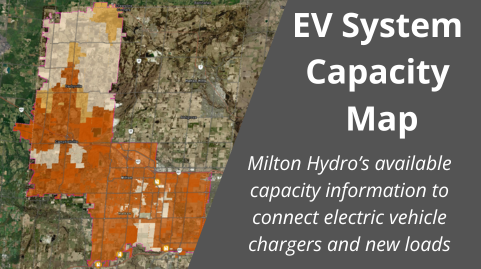
EV System Capacity Map
Curious about the available electrical load* capacity in neighborhoods throughout the Milton Hydro service area? Check out our Capacity Map.
*Please note that the MH EV Capacity Map is solely meant for capacity to install EV charging systems.
If you have questions about the process before you apply, please contact our Engineering Department at (905) 876-4611 or
engineering@miltonhydro.com for a free consultation.
All new services shall be rated a minimum 200A up to the demarcation point. Milton Hydro’s standard voltage offerings are:
- 120/240V (single phase)
- 120/208V or 600/347V (three phase, four wire)
All new, upgraded, or modified services shall be installed as per Milton Hydro’s
Conditions of Service.

Service Layout Process:
- Complete the Electrical Requirements Summary form and submit to engineering@miltonhydro.com.
- Once your application has been received, an Engineering Technician will contact you within 10-15 business days to discuss your request and set up a site meeting, if required.
- You will receive an Offer to Connect letter and Service Layout (site drawings) along with specifications and connection requirements within about 60 days once Milton Hydro has received all necessary information for the service.
- The Offer to Connect will show the Connection Fees required to complete the work and how to proceed with your project.
- If the application is for a new electrical service, the applicant will receive an Electricity Account Application. This form is to be completed by the customer who will pay the electricity bill at the address.
- The applicant’s qualified electrical contractor will perform their work and have the Electrical Safety Authority (ESA) inspect the work on the customers’ side of the demarcation point. Milton Hydro requires the ESA’s Connection Authorization for any service connection.
- For most residential service upgrades, the electrical connection can be coordinated by calling Milton Hydro’s Engineering Department
- Where construction is required, such as a service trench, pole, anchor, or transformer installation the applicant or their contractor should be coordinating their project with Milton Hydro’s Engineering Technician that prepared the Offer to Connect.
- Depending on the type of work being completed, Milton Hydro inspections may be required. This will be communicated to you as part of the Offer to Connect.
- Once ESA Connection Authorization is completed, Milton Hydro will schedule work to complete the connection within 5-10 business.
Timing:
Customers requiring new services should contact Milton Hydro’s Engineering Department (
engineering@miltonhdyro.com or (905) 876-4611) as early in their process as possible to communicate requirements and timing. Some material that Milton Hydro orders, such as high voltage switches, switchgear, and transformers can take upwards of 12 months to receive.
Customers, especially those applying for commercial services, should submit their site plan drawings, single line diagrams, and equipment specifications (ie: high-voltage switchgear) with their application. Milton Hydro’s Engineering Department will advise of any missing information that is required to complete your submission. Failure to not submit documentation may delay your project.
Construction Standards:
The following documents are some of Milton Hydro’s construction standards related to new services and upgrades to services. Milton Hydro’s Engineering Department will identify the appropriate standards for your service request, which may include those below, and others.
These construction standards are intended to provide guidance for construction and are not meant to take the place of a service layout request.
+ When do I need a Service Layout?
If you are building a new home or business or you are upgrading or modifying your existing service or meter location, you need a Service Layout.
+ I’m building a new house on a rural property. How far can I build my house from the road before I need a primary service and transformer on the property?
Generally speaking, if you construct a house more than about 90m (270ft) from the road you may require an overhead pole line or underground trenched service with transformer on property. Contact Milton Hydro’s Engineering Department to determine appropriate servicing methods for your property at
engineering@miltonhydro.com.
+ Who installs an underground service?
The customer is responsible for installing underground services including transformer base, ground loop, primary and secondary trenches, conduit, meter base/ cabinet, and primary/ secondary cables (if owned by the customer).
Milton Hydro will supply and install most primary and secondary cabling that will be owned by Milton Hydro. The Offer to Connect and Service Layout for your specific site will provide greater details of our requirements.
+ I am building a new house/ business where there are no power lines. How do I get power to the site?
To begin the process of getting power to your property, complete the
Electrical Requirements Summary Form at the top of this page. We will work with you to establish the best method for getting power to your site, timeframe, and costs. You can also contact the Engineering Department at
engineering@miltonhydro.com or (905) 876-4611 and ask for a consultation.
+ How close can I build my house/ business to a power line?
Buildings should be constructed at minimum of 5m (16ft) from an overhead power line to ensure safety. This minimum meets the Ontario Building Code requirements and Ontario Electrical Safety Code requirements related to proximity of buildings to electrical power lines.
+ Milton Hydro’s website has many construction standards. Can I use these for my service?
The Construction Standards are posted on this page for ease of customer access. The specific standards that apply to your situation will be provided to you as part of the Service Layout process.
+ DEVELOPER - I am building a new residential or business development and a system expansion is required.
The Ontario Energy Board (OEB) is developing a Capacity Allocation Model (CAM) to manage how limited electricity system capacity is allocated for new connections, particularly in growing residential developments. CAM aims to create a transparent, standardized process for prioritizing projects when grid capacity is constrained, reducing uncertainty and delays for developers. By clarifying allocation rules and aligning them with Ontario’s housing growth objectives, CAM helps developers plan projects more effectively and avoid costly redesigns or cancellations. This process also supports fair access to capacity, ensuring that system expansions and upgrades are coordinated to meet increasing demand efficiently.
Milton Hydro's minimum service size is 200A, with an estimated demand load of 3-5kW per average residential service.
Developers planning projects within the Milton Hydro service area should refer to the CAM Appendix linked below and the OEB's website (https://engagewithus.oeb.ca/system-expansion-for-housing-developments-consultation) for more information.
CAM-Appendix_20250417.PDF
+ What is the CCIM?
- The CCIM is an online tool created by the OEB to give users a high-level view of where there’s available capacity on Ontario’s electricity distribution systems. In simple terms, it helps users see two main things:
- Available load capacity: The ability to serve new or expanded electricity demand.
- Available hosting capacity for DERs: The ability to connect new projects like solar panels, wind turbines, or battery storage.
+ How to use the CCIM?
The CCIM is a planning aid, designed for early-stage screening. Users can use the tool to quickly check which areas might be suitable for their project before contacting a distributor. The map shows capacity in broad ranges and reflects system conditions at the time distributors submitted their data. It’s not a substitute for detailed assessments, as conditions can change and every project has unique requirements.
+ What is the difference between the available load capacity and the available DER hosting capacity map environments?
- The CCIM provides two distinct map environments because they serve different purposes:
- The Available DER Hosting Capacity map environment focuses on the ability of the grid to integrate DERs like solar panels, battery storage or other generation facilities. It highlights where the system is expected to be able to host additional generation without causing reliability or safety issues. Data is provided for a range of typical project types, such as inverter- or non-inverter based installations, as well as for projects designed only to displace a customer’s load rather than inject power.
- The Available Load Capacity map environment shows areas of the electricity distribution system that can accommodate new customer loads—such as housing developments, commercial buildings, or industrial facilities—without requiring major system upgrades. This helps businesses and developers identify locations where connecting new demand is likely to be simpler and faster.
Both map environments are intended for preliminary screening only and do not replace any formal connection application or Connection Impact Assessment (CIA) process. They provide early insights to help users plan projects and reduce uncertainty before engaging in detailed engineering studies.
+ Who should use the CCIM?
The CCIM is designed for anyone planning electricity-related projects in Ontario. Key stakeholders include:
- Large energy consumers evaluating suitable locations for new facilities.
- Municipal planners and consultants seeking high-level capacity insights for community growth or electrification strategies.
- Renewable energy and DER developers assessing where solar, wind, or battery projects can be hosted without major grid upgrades.
- Project developers and businesses looking to identify areas where new or expanded electricity demand can be connected easily.
- The CCIM provides early-stage screening to reduce uncertainty before engaging distributors for detailed assessments.